Reconstitution: bacteriostatic water, syringe math, and storage
Mixing a lyophilized peptide vial is the most error-prone step in self-administration. Here is the math, the technique, and the storage rules — with a calculator you can drive yourself.
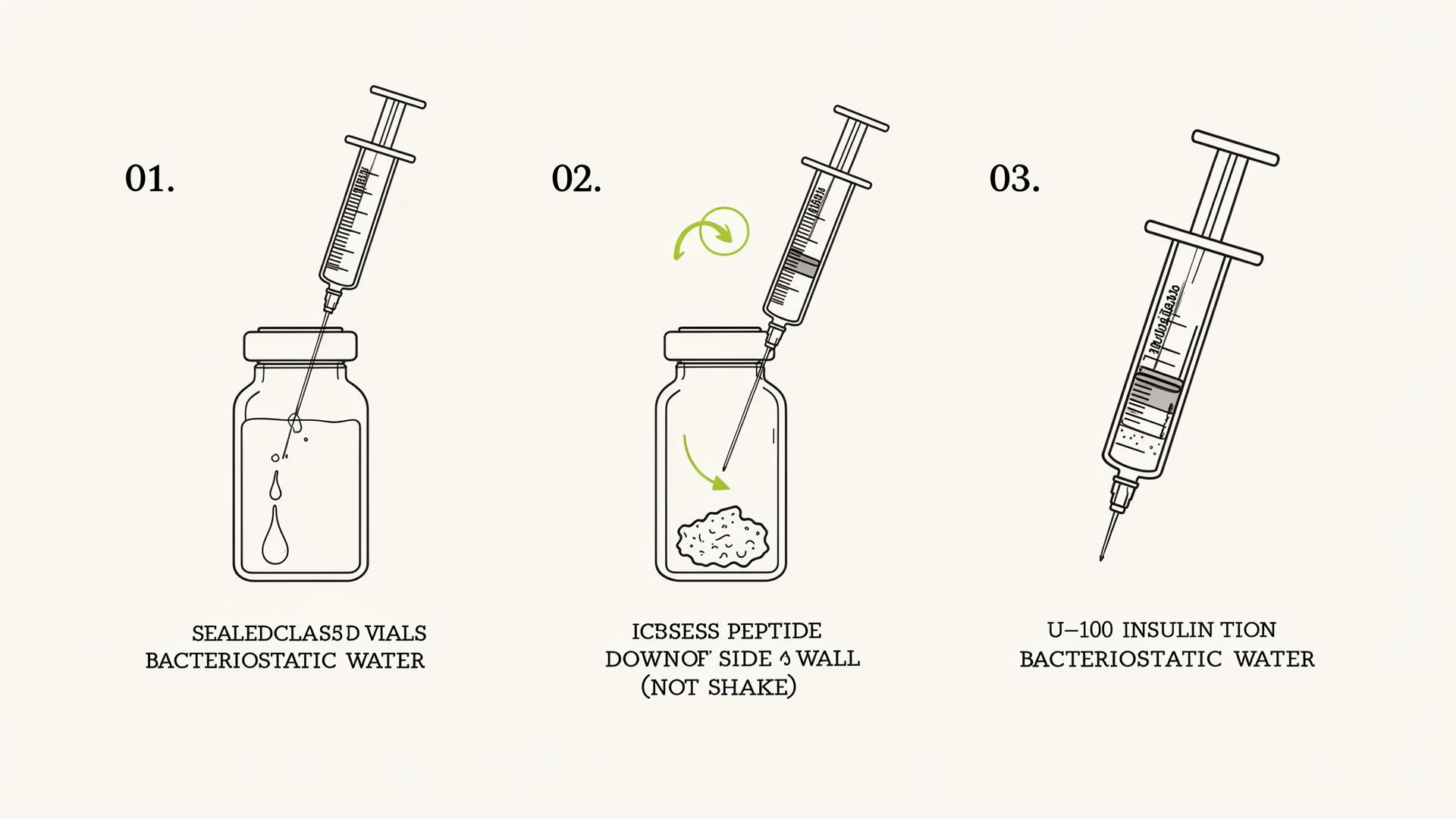
What you are actually doing
Most peptides ship lyophilized — freeze-dried into a fluffy white or off-white cake at the bottom of a sealed vial. To use them you need to dissolve the cake in a sterile diluent, calculate the resulting concentration, and draw the right volume into a syringe. That is the entire job, but each step has a way to go wrong.
Bacteriostatic water vs sterile water vs saline
Bacteriostatic water for injection (BAC) contains 0.9% benzyl alcohol, which suppresses microbial growth and lets a reconstituted vial sit in the fridge for weeks. It is the right diluent for almost every peptide.
Sterile water for injection (SWFI) is preservative-free and only safe to use within a few hours of being opened. It is appropriate for compounds that interact badly with benzyl alcohol (rare in this category) and for single-dose situations.
Normal saline is occasionally specified for nasal sprays. Do not substitute it for bac water in injectables without a reason.
Technique, in order
Done well, reconstitution takes under two minutes and stays sterile end-to-end.
- Wash hands. Wipe the rubber stopper of both the peptide vial and the bac water vial with a fresh alcohol prep pad.
- Draw your bac water with a sterile syringe (a 3 mL or 5 mL slip-tip with a 21G drawing needle is standard).
- Insert the needle into the peptide vial at an angle and let the bac water trickle down the inside wall — do NOT jet it directly onto the lyophilized cake, which can shear and denature the peptide.
- Swirl gently. Do not shake. If the cake is slow to dissolve, leave it on the counter for 5–10 minutes; it will dissolve.
- Label the vial with the date reconstituted and the concentration in mcg/mL. Refrigerate at 2–8 °C.
The math
The only formula you need:
Concentration (mcg/mL) = Vial amount (mg) × 1,000 ÷ Bac water added (mL)
Volume to draw (mL) = Desired dose (mcg) ÷ Concentration (mcg/mL)
For a U-100 insulin syringe, multiply the volume by 100 to get the unit markings. So a 5 mg vial in 2 mL of bac water = 2,500 mcg/mL. A 250 mcg dose = 0.1 mL = 10 units on a U-100 syringe.
Education only · Not a dosing recommendation · Always confirm math with a clinician.
How much water to add
There is no chemically correct answer — only practical ones. More water means easier-to-measure draws (more units per dose) at the cost of more frequent refrigerated volume. Less water means smaller draws and more doses per vial at the cost of measurement error.
A good default for most GH secretagogues, BPC-157, and TB-500 is 1–2 mL of bac water per 5 mg vial. For peptides where you are dosing in single-digit mcg (PT-141 micro-dosing, MT-II), use more water so the draw is at least 5 units — drawing 1 unit on an insulin syringe is unreliable.
Storage and stability
Reconstituted peptides are not forever-stable. Rules of thumb:
- Refrigerate at 2–8 °C in the original vial — not in pre-filled syringes.
- Most peptides remain stable for 3–4 weeks reconstituted in bac water. GLP-1s (semaglutide, tirzepatide) follow their labeled in-use periods, typically 4–6 weeks.
- Do not freeze a reconstituted vial. Freeze-thaw cycles destroy peptide integrity.
- If the solution becomes cloudy, develops particles, or changes color, discard. Do not inject it.
- Travel with reconstituted peptides in an insulated bag with a cold pack. Brief room-temperature excursions are tolerated by most peptides; sustained heat is not.
Common reconstitution mistakes
Recurring patterns we see in the field:
- Jetting bac water directly onto the cake and producing a foam — that foam is denatured protein.
- Shaking the vial vigorously. Swirl, never shake.
- Reusing the same drawing needle across multiple vials. Use a fresh needle per vial.
- Forgetting to label, then losing track of which vial is which concentration two weeks later.
- Drawing a dose, capping the syringe, and leaving it on the counter for 'later'. Always draw immediately before injecting.
Can I use tap water or distilled water?+
No. Neither is sterile, and both will introduce bacteria into a product you are injecting under your skin. Use bacteriostatic water for injection or sterile water for injection only.
My vial says 'do not exceed 5 mL of diluent' — why?+
Most vials are 3 mL or 10 mL nominal. The limit is mechanical — past the marked volume the vial overflows when you withdraw. It is not a chemistry constraint on the peptide.
How long can I keep a reconstituted vial in the fridge?+
For most research peptides reconstituted in bacteriostatic water, 3–4 weeks is the practical limit. FDA-approved compounds follow their labeled in-use period (commonly 4–6 weeks for GLP-1 pens). After that, discard.
What needle gauge should I use?+
A 27–31 gauge insulin syringe with a 5/16 inch (8 mm) needle is standard for subq injection in adults. Smaller numbers are larger needles. Most users prefer 29G or 31G for comfort.